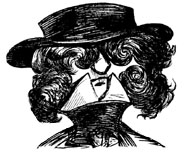
G.K. Chesterton, a Curmudgeon for Our Times
UNDENOMINATIONAL RELIGION & OTHER FOLLIES
I got a bit worried the other day when a friend told me I was sounding “more and more like G.K. Chesterton” in my volleys against much of our contemporary cultural consensus. I didn’t know Chesterton save by reputation — a “conservative” and a curmudgeon. So I went to the library and snagged his essay collection called Heretics. Much of it spoke to the very particular figures of his time and, since I didn’t know them, I passed these bits by quickly, nevertheless enjoying the way Chesterton sallies forth, a twinkle in his eye and indelible ink on his pen, to take them on. But I couldn’t “get into it,” as we like to say these days.
As for the rest, well, I was both charmed and instructed. Charmed because the fellow knows how to write — always a pleasure for an academic dulled by the dead prose of the academy — and instructed because the fellow knows how to think, perhaps an ever rarer virtue these days. So much of what exercised Chesterton in his epoch continues to haunt us; indeed, if anything, Chesterton possessed the uncanny ability to foreshadow our own raging discontents. For example, in an essay on “Heretics,” he makes the incontrovertible (but often forgotten) point that blasphemy “depends upon belief and is fading with it. If anyone doubts this, let him sit down seriously and try to think blasphemous thoughts about Thor. I think his family will find him at the end of the day in a state of exhaustion.”
With a slight shift of emphasis, Chesterton’s observation helps us think about our own version of that banality sometimes called evil. I have in mind, say, Madonna’s shenanigans, all the exhibitionistic self-referentiality and the bold declarations of what could scarcely be more drearily conformist. Those who would visit down hail and brimstone on her head have got it wrong — it is like thinking blasphemous thoughts about Thor. Madonna isn’t really evil, just banal. Moreover, Chesterton helps out on “good” as well as “evil” when he notes, in his essay “On the Negative Spirit,” that much popular phrasemaking “is a dodge in order to shirk the problem of what is good.” Thus much of our talk of liberty, including leaving “all these arbitrary standards” behind in order to “embrace liberty” more fully, is just another way of saying, “Let us not decide what is good, but let it be considered good not to decide it.” A neat trick, perhaps, but pretty thin gruel if you think about it for more than the time required to shout “Oprah Winfrey.”
So, modern-minded people don’t burden their young people with talk about responsibility, preferring to give them condoms.

In “Mr. H.G. Wells and the Giants,” Wells comes in for a drubbing along rather similar lines. Wells, in his Utopia, makes it a chief point to institutionalize a “disbelief in original sin.” How strange, Chesterton muses, for if Wells had simply begun with himself he would have “found original sin almost the first thing to be believed in,” that “a permanent possibility of selfishness arises from the mere fact of having a self and not from any accidents of education or ill-treatment.” We certainly don’t like to hear this kind of talk nor, apparently, did Wells, who wanted to eliminate all conflict. This meant creating a world in which nobody cares very much about anything. How dull, suggests our curmudgeon, and how impossible, finally. Chesterton also opines, quite provocatively, that if we give up on original sin, we give up on human equality, for original sin has it that all human beings can be tempted; none is exempt, and from this conviction one can build a social order that does not presume a pure and virtuous class counterpoised against those who have yet to see the light.
Another target for Chesterton is zany racialist arguments, whether for or against “Celts” or anybody else. Defense of the Anglo-Saxon race is utterly daft (“this absurd deity of race”), for starters because nationality is not the same as race. Moreover, the “man of science” who begins to pronounce on the “savages” finds them wanting in rationality (like John Stuart Mill, who pitted barbarians still in the grip of Instinct against good Englishmen dominated by Reason.) The poor benighted folks in the sway of Instinct are objected to because of their devotion to “ceremonials and religion.” This obviously brands them as childish. But, of course, the racialists and rationalists (for reasons that often, uncomfortably, impinge) also find many of their own countrymen childish, dependent upon such obviously irrational institutions as the family.
But the defenders of the family usually get it wrong too. A family is “not a haven. No, rather, when one lives in a small community not wholly of one’s own choosing, one comes to know much of the…uncompromising divergencies of men.” A clan is heterogeneous. By contrast, a clique, a club, or a political cohort is homogeneous. Perhaps this is why we are urged by Christianity to love the actual people in front of us, simply because they are there. The British diplomat hanging out with his Japanese counterpart is not in a world of real difference: “if what he wants is people different from himself, he had much better stop at home and discuss religion with the housemaid.”
The family often involves circumstances over which we have no control, or less than we would like. Chesterton would no doubt echo the words of contemporary novelist Sue Miller who fills her splendid volume, Family Pictures, with unblinkered lore about the “messy, careless reality” that lies at the heart of every family. For the rationalist this is something to run away from. He always fears he will be thought sentimental by his peers. Poor fellow: His world is pinched.
Two additional essays — “Concluding Remarks on the Importance of Orthodoxy” and “Christmas and the Aesthetes” — capture a worldview we are in danger of losing altogether, save as some museum piece, an object of curiositas. In the first essay we learn that mental advance means “coming to conclusions, growing into definite convictions…. Turnips are singularly broad-minded.” People who have no convictions strive most strenuously to foist off their convictionlessness on the rest of us, for our own enlightenment of course. “The modern world is filled with men who hold dogmas so strongly that they do not even know they are dogmas.” Progress is one such dogma, but it is a dogma not thought dogmatic.
The “Christmas” piece is a small gem. Chesterton takes out after the “aesthetes” who would turn Christmas into an insipid “worship of humanity.” Such folks often opt for “undenominational religions” that “profess to include what is beautiful in all creeds.” But what they actually accomplish is to collect “all that is dull in them. All the colours mixed together…on any human paint-box…make a thing like mud, and a thing very like many new religions.” The person of faith must be prepared to be both “martyr” and “fool.” Actually, though, there are good reasons why we don’t “hang up stockings on the eve of the birthday of Victor Hugo” or “sing carols descriptive of the infancy of Ibsen outside people’s doors in the snow.”
If this be curmudgeonly reaction, we need more of it.
You May Also Enjoy
We travel under the pretense of being receptive, really looking for what we think we already know. Yet we are occasionally genuinely surprised.
If you favor the cause of orthodoxy or tradition in Catholic faith and morals, you should break the close link that exists between that cause and the cause of the political Right.
Although Chesterton cultivated a streak of romanticism and delighted in excursions into fantasyland, the source and inspiration for distributism lay elsewhere.