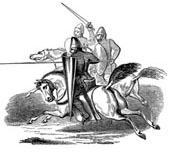
Tolkien’s Insights into the Masculine Soul
THE CALL OF CHIVALRY
What is a woman? People today find it difficult to answer this question. How many could answer the related question, What is a man? For modern psychologists and those influenced by them (which is practically everyone), “masculinity” and “femininity” are not directly equivalent or applicable to “man” and “woman.” You can just as easily be a feminine man or masculine woman, “identifying” contrary to your biological sex and then trying, through clothing, cosmetics, pronouns, and even surgery, to conform your body and appearance to this subjective identity. Though this attempt is disordered, it also unintentionally reveals something: Masculinity is intrinsically associated with being a man, and femininity with being a woman.
What does this have to do with J.R.R. Tolkien? As a traditional Catholic, not merely a “product of his time” but a product of the Truth, which is universal and perennial, he believed what most people clearly recognized before the proliferation of feminism, psychologism, and transgenderism: The body is a gift from God that, in union with the soul, forms one integral person. Therefore, the sex of your body is determined by God and is perfectly suited to your soul; it’s not something to be bulldozed and rebuilt according to the mechanistic mentality of the Industrial Age.
In this light, Tolkien knew that men and women are inherently distinct in both body and mind, while still being equal in their shared human nature, and that these distinctions are expressed as masculinity and femininity. How each is represented in individual men and women varies, of course, and what determines their precise forms depends on culture and changing fashions — but the distinction will always exist and thus should be upheld as an immutable principle. As Tolkien wrote in his explanation of the pre-existence of the Music of the Ainur in the mind of Ilúvatar: “It is the view of the Myth that in (say) Elves and Men ‘sex’ is only an expression in physical or biological terms of a difference of nature in the ‘spirit,’ not the ultimate cause of the difference between femininity and masculinity” (The Letters of J.R.R. Tolkien, 2012).
Tolkien shows this distinction in his stories, while also corroborating them in his nonfiction writings. I addressed the topic of femininity in “Tolkien’s Insights into the Feminine Soul” (Nov. 2025). Now I would like to focus on his portrayal of men and masculinity.


You May Also Enjoy
She believes a good fiction writer intuitively adopts a sacramental and liturgical view of creation and is therefore able to portray the spiritual in the ordinary.
To the list of things Jesus could have been but wasn’t, there is now one more to add: A new movement would recast Our Lord as a transgender woman.
"Every consonance or harmony, every concord, every friendship and union," Maritain writes, "proceeds from the divine beauty…which gathers all things together and calls them to itself."