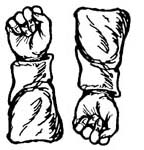
Fr. Hanlon’s Strong Hands
GUEST COLUMN
When I was an altar boy from the mid-1960s to the early 1970s, I served mostly at the Church of the Assumption of the Blessed Virgin Mary in Colesville, Penn. Assumption BVM was a part of the newly created Diocese of Allentown. Previously, the Allentown Diocese had been part of the Archdiocese of Philadelphia.
Our parish priest, the Rev. James Hanlon, was from Brewerytown, one of the German-Irish neighborhoods which no longer exist in Philadelphia.
For a rural parish, we were pretty “high church,” as the Anglicans say. Benediction, stations, 40 hours devotion, the May Day procession of our Lady and Eucharistic processions on Corpus Christi, Christ the King, and Holy Thursday. If the Pope himself had dropped by Assumption BVM for a drink, he would have felt right at home.
Fr. Hanlon had us altar boys listen to records so we could get Latin pronunciations right. He taught us how to walk, how to stand, how to use the censer, how to chant, and, most importantly, how to look a big crowd in the eye and maintain our composure. “If you ever drop the Cross during a procession,” he said to me one time (I was the tallest altar boy; everything I do well in court as a lawyer I learned from him), “make it look like part of the ritual.”
You May Also Enjoy
Here we review Failing Foundations: The Pillars of the West Are Nearing Collapse, by Sarah Cain.
Simplicity and stability, as with solitude and silence, constitute the conditions within which the Carthusian seeks God.
Ecumania is burning itself out. Nevertheless, the Catholic Church's bilateral ecumenical dialogues just go on and on.