Every Life a Mass
ONE FOOT ON EARTH & ONE IN HEAVEN
It is a rare thing to capture life in a moment, but when we do, we find one foot on Earth and the other somehow in Heaven. Nowhere is this truer than in the Holy Sacrifice of the Mass. Indeed, unlike any other transcendent experience, the Mass contains the whole breadth and depth of life. It is active and passive, spirit and matter, communal and personal, common and extraordinary, joy and sorrow, immediate and eternal. It is birth and death and resurrection, again and again.
When an adult Catholic walks into her parish church, she enters the bosom of Holy Mother Church. At the threshold, she dips a finger in holy water and crosses herself. In doing so, she remembers and relives her Baptism when she was “born again” — that is, reborn as a child of God. She might even recall her trials and wrestling with God — in a word, the labor pains — that precipitated her Baptism. Now, she is allowed rest, away from the world; she is at home.
Taking a pew, she waits to meet the priest as passively as a newborn babe awaiting the arms of her father. The priest enters in a procession with Christ lifted high, as if to exercise her young neck, strengthening it so she may hold her gaze toward Heaven.
After the greeting, she has aged to toddlerhood, when a child first begins to sin. Those sins must be accounted for, and they are in the Penitential Act, the Kyrie, and the Gloria. During this time, she makes her apology, is forgiven, and sings of how good the Father is. Reconciliation has occurred, and she may grow up further.

Entering the Liturgy of the Word, the woman in the pew has aged to early adolescence. She is sung to from the Psalms, and to her ears they are as lovely as nursery rhymes. Next it is story time, the Scripture readings. She hears tales of yore from the Old Testament, tales of honor and beauty; she hears fatherly wisdom from an Epistle; and then the “true myth,” the Gospel. As any good father would, the priest invites his child to recite what she has learned. And so she does in the Creed.
Then, as before any meal, the father leads his family in prayer. But this is no ordinary meal, for the woman has aged further still. She looks on the consecration of the host as a woman in the flush of young adulthood, and this is her marriage feast. Before her is her Bridegroom, fully present in the transubstantiated bread and wine. She has been kneeling for some time, preparing her soul for union.
At last, she is ready to walk down the aisle to her Groom. The veil she donned upon arrival now takes on a whole new purpose as she stands before the altar. She receives Him, and they are one. She is now “through him, with him, and in him, in the unity of the Holy Spirit.” Upon this consummation, she receives the seed of eternal life, His seed. With faith, hope, and charity, this seed will grow to bear much fruit. But that fruit is not meant for her; it is for the starving world outside.
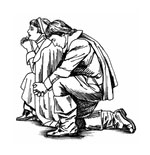
She returns to her seat and, rapt in His glory, kneels again, only this time, she has aged even further. She closes her eyes, bows her head, and folds her hands — the exact pose she will assume at her funeral. This is fitting, for she joins Christ her Bridegroom as He is entombed within the tabernacle, just as He was entombed after His original sacrifice. While all this takes place, she is praying fervently. Her soul is lifted to Heaven just as surely as Christ ascended there. And there she and He will enjoy an eternal honeymoon.
But this is only a fleeting foretaste; her time has not come yet. For now, she must wait patiently, receiving one last blessing from the priest before being sent into the world again. In a manner of speaking, she has been resurrected. She has lived the lifecycle of a saint in the Mass, and yet the Mass has infused her with a newness of life. With it, she is commissioned to bring the Heaven she tasted to Earth — that is, until she comes back next Sunday, a babe once more.
©2026 New Oxford Review. All Rights Reserved.
To submit a Letter to the Editor, click here.
You May Also Enjoy
We should take the Catholic adage ‘what you pray is what you believe’ as an urgent warning.
The charismatic quest for paranormal experiences of God is also a contrived pseudo-communion of ecstatic emotional dissolution.
After attending various Masses and talking with parishioners, we came to the conclusion that parish success or decline depends on the homily of the pastor.