Calling Catholics Back from the Cliff
Robert McTeigue
“There were giants on the earth in those days…” — Genesis 6:4
To paraphrase King Théoden of The Lord of the Rings, we live in a time of “lesser sons of greater sires.” I find myself reading more and more of Popes Leo XIII, St. Pius X, and Pius XI, as well as Louis-Édouard-François-Desiré Cardinal Pie, Étienne Gilson, Josef Pieper, and Christopher Dawson. At the same time, my work in media requires me to spend time with the words of synodal reports and the musings of progressives such as cardinals Blase Cupich, Victor Fernández, Timothy Radcliffe, and Arthur Roche, as well as Andrea Grillo and Austen Ivereigh. Suffice it to say that the differences between the two groups are noticeable and undeniable.
Reflecting on those differences stirs up a memory from my student days. I was privileged to study under the renowned Thomist Fr. John F. Wippel. At the time, he said something that made me bristle: “My biggest fear is to be remembered to posterity by the notebooks of my students.” I was a diligent student, and I thought my notebooks would do him justice. Years later, when I was teaching and saw the notebooks of my own students, I understood his apprehension. I would often ask them, “How could you get that from what we read? From what I said?” What they jotted down gave no indication that they had read the assigned texts or heard any of my lectures. “You can’t get there from here” was a common admonition. I found myself frequently writing in the margins of their essays, “You need to reconsider your method of preparation,” and “What you’ve written here casts doubt on your familiarity with the relevant texts.” (Keep those two phrases in mind.)
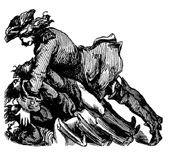
In a similar spirit, as I read the inspiring work of great Catholics from the not-so-distant past and then the work of all-too-many contemporary Catholics, I find myself saying, “You can’t get there from here.” In other words, what is written and said by “leading” contemporary Catholics, especially Catholics of the “Synodal School,” seems possible only if they have not read (with understanding) anything of the giants of the recent past. My perception is that many leading contemporary Catholics are “progressing” us right off a cliff — a cliff clearly demarcated by the writings of hierarchs and scholars of just a generation or two ago. Mustn’t there be an alternative to following the conga line off the cliff?
I make bold to suggest that scrutiny of key texts from our great forebears can redirect those who insist that charging off the cliff can only lead to better days. In so suggesting, I’m aware that some enthusiasts might recoil in horror at the prospect of “turning back the clock,” as they see no merit in the past apart from “directions desired” and “orientations of the Second Vatican Council.” Let’s take up the challenge of winning them over to a future that does not entail unnecessary plummeting.
You May Also Enjoy
I saw John Paul II in prayer on television, then I saw a common laborer in prayer in a church. I knew that each was far richer than I could imagine.
All nine popes who have guided the Church since 1917 have had a personal devotion to Our Lady of Fatima.
The grace of marriage allows the parties to become one flesh and calls forth from them the same love Christ has for His Church.