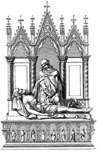
A Tale of Two St. Mary’s Churches
DO THEY BELONG TO THE SAME RELIGION?
It was Pentecost Sunday 1999, and we were headed to 8 a.m. Mass at St. Mary’s Church in upstate New York. We — my wife, kids, and I — had traveled from Pennsylvania to visit my wife’s family, and I decided to take my kids (my wife had other obligations) to St. Mary’s where Grandma is a Eucharistic minister.
At 7:45 a.m. we entered St. Mary’s and briefly stopped to observe her modern interior design. It was not exactly the traditional rectangular church with the altar at one end and an entrance at the other. St. Mary’s is rectangular, but the “altar area” is located near the middle of the nave, not at the end. Multiple banks of pews face the altar area, some at an angle, surrounding it on three sides. The nave is devoid of statues and artwork. It appeared more like an auditorium than a place of worship.
While the interior seemed odd to me, I was there to worship God, not rate the architecture. So we genuflected and entered our pew where I would kneel and offer up my prayer intentions for the Mass. And kneel I did, on the hard terrazzo floor, for this church has no kneelers. As always before Mass, I lifted my head to focus on the Tabernacle in silent prayer. I cast a glance into the “sanctuary,” but there was nothing that looked even remotely like a Tabernacle. I then panned the nave and still saw no Tabernacle.
At this point, I wondered if I had inadvertently taken my kids to a non-Catholic church. I hadn’t quizzed Grandma on her place of worship. I assumed she was Catholic; after all, she was a Eucharistic minister at St. Mary’s. I began to perspire as I tried to make sense of my surroundings.


You May Also Enjoy
Niebuhr was the most extraordinary of preachers — a powerfully compelling delivery, all extemporaneous. As a teacher he called upon history and politics with great ease.
Not long after the same-sex marriage battles have begun we are beginning to hear promotion of polygamy, three-parent laws, and even talk of legal incest.
Chesterton opines that if we give up on original sin, we give up on human equality, for original sin has it that all human beings can be tempted; none is exempt.