Time, God and Change 3
The Block Universe Controversy

Before proceeding to the Block Universe Controversy, I’ll give some background material to make time, as a variable in space-time, intelligible in the context of relativity theory. If the reader finds sections of this article too challenging, please skim those sections but be sure to read the final section offering my arguments against the block universe theory. In Part 4 I will draw these articles together into a context of what faith and revelation tell us about time and creation. Before I discuss what is meant by a block universe, I want to note that the theory of relativity has changed our view of time from an absolute dimension to one that depends on how we’re moving and where we are. The view of time as an absolute dimension was proposed by Newton and seemed reasonable until Einstein came up with his theory of special relativity over 100 years ago.
Newton considered that all motion is relative to some “frame of reference” that is considered to be at rest. For example, if you’re walking in an airplane, your velocity can be considered relative to the airplane as if it were at rest, maybe 1 meter per second. If you consider your velocity relative to the earth, you have to add or subtract the airplane’s speed, depending on whether you’re walking to the front or to the back of the plane.
What was Newton’s ultimate frame of reference? He posited that the universe consists of “absolute space” and “absolute time.” All motion was relative to this basic, non-moving entity. There is no way to empirically verify this notion, so one can regard it as an axiom — a self-evident truth like Euclid’s axiom that parallel lines never meet; as with that axiom, it is contradicted by contemporary physics.
EINSTEIN AND SPECIAL RELATIVITY
How did Einstein’s theory of special relativity alter Newton’s picture? He made the revolutionary suggestion in his famous 1905 paper that time was not absolute: namely, the variation of time measurements in different moving reference frames was not a calculation artifice but a real phenomenon. Here’s Einstein’s “Thought Experiment” to illustrate this concept:
An observer on the platform, if the lightning bolts strike the front and back of the train just when the center of the train is in front of him, will regard the lightning bolts as striking at the same time, simultaneously, since he is in the middle of the train when the lightning bolts strike. An observer sitting in the middle of the moving train will see the lightning from the front before the lightning from the back, since he is moving toward the front and the distance traveled by the light from the front will be less than the distance traveled by the light from the back…
Which time, that of the platform observer or that of the train observer, is correct? Both, according to Einstein. In other words, there is no absolute time! And this assumption has been verified since then by many measurements, including satellite GPS corrections and cosmic ray measurements.
From this thought experiment one can conclude that events which are simultaneous in one frame of reference may not be simultaneous in another. Moreover, length measurements vary according to the reference frame in which the measurements take place (the Fitzgerald-Lorentz Contraction). Accordingly, there is not an absolute space—a frame at rest with respect to any other possible frame of reference. This linkage of length contraction and time dilation leads to the idea of mixed up space and time dimensions, or “spacetime.”
SPACETIME, LIGHT CONES, WORLD LINES
In physics one searches for invariants: quantities that remain the same even when you change the way of looking at a system. In classical physics, one such invariant is the distance between two stationary points, A and B. Would there be an equivalent invariant in the new, relativistic picture? Yes! Two years after Einstein published his special relativity paper, Hermann Minkowski proposed that spatial coordinates x, y, z, and time t, could be combined in a four-dimensional space-time. In this spacetime there was an invariant s, the distance in spacetime. Note that pictorial representation of that four-dimensional spacetime (see below) will have to be a two-dimensional slice of a three-dimensional slice of a four-dimensional entitity—we can’t visualize four dimensions readily.
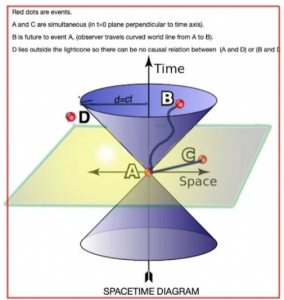
Let’s try to visualize what this invariance means. Consider a sphere: if you move on the surface of a sphere, the spatial coordinates x, y, z will change, but the distance to the center of the sphere, its radius r, will remain constant. Similarly, if you move on the surface of a four-dimensional spacetime sphere, the spatial distance d and the time t may change, but they’ll change in such a way that the spacetime distance s from the center of the spacetime sphere is constant.
In the spacetime diagram below, the top cone represents the future and the bottom cone the past. Light travels on the cone surface; light from the past reaches event A; light from event A reaches future points. Since the speed of light is constant, independent of the reference frame, the cone surface is the same for all observers. However, within the cone, what would be the horizontal cross-section for one reference frame (observer) could be a tilted cross-section for another with a different reference frame.
CAUSALITY AND THE BLOCK UNIVERSE
We assume the requirement that the square of the space-time distance is not negative. Then the time order of events is preserved in special relativity if events lie in the same light cone. Given this condition, if event A precedes (timewise) event B in one reference frame, “it can be shown” that A will precede B in all other reference frames. Thus the required time order for “A causes B” is preserved in all reference frames. Nevertheless some philosophers maintain that the lack of universal simultaneity in a light cone picture implies that all events in future and past are equally real (“have ontological status”). If that is the case, events both future and past are set in the universe. The universe is pictured as a four dimensional block of spacetime (hence “block universe”) in which events are located at particular spacetime points.
Needless to say, it’s difficult for those of us who believe in free will to credit this picture. If future events are “there,” preordained, there seems to be nothing the individual can do to change the course of the future. We pass from one event to another, like passengers on a train controlled by an unknown engineer. Not all physicists and philosophers agree with the block universe interpretation. Two physicists, Christopher Isham and John Polkinghorne, debated the truth and utility of the block universe at a Conference on Quantum Cosmology called by Pope St. John Paul II. The debate is summarized here. The arguments against the Block Universe as a metaphysical fundamental are presented below.
AGAINST A BLOCK UNIVERSE
I believe that the best argument against the Block Universe as a valid metaphysical construct follows from how science works. Unlike dogma, scientific theories change with time as new data demands new theories. To credit the ultimate reality of a block universe requires one to believe current science is the only truth. One participant in the debate argued that treating the block universe as ontologically real is scientism of the worst sort, letting physical theories dictate content in philosophy and theology.
In other words, such a block universe requires belief beyond common sense. One hundred years from now what new theory might do away with the idea of a block universe? Indeed, present physical theory is not all that consistent with a unified view of the nature of time. The irreversibility of the real universe, entropy as “the arrow of time,” is not yet explained by the time symmetry of fundamental physics.
In the last of this series, part 4 (here), I will draw these articles together into a context of what faith and revelation tell us about time and creation.
[A link to part 2 is here. Part 4 is here.]
From The Narthex
This new blog series addresses certain liturgical changes in the Latin Rite Mass, from the…
SNAP Shutdown The continuing shutdown of the federal government has interrupted SNAP payments. SNAP is…
Pop quiz: Which major ecclesial body recently described itself as a “trans” church? Need a…