Time, God and Change 1
Creation, Eternity and Human Experience

“What then is time? If no one asks me, I know what it is. If I wish to explain it to him who asks, I do not know.” — St. Augustine of Hippo
At 96 I sometimes view time as an enemy, not a friend. So much to do! So little time left to do it! But then I think back to what I’ve learned since my conversion to the Catholic faith 31 years ago and realize that time is part of God’s creation, a very necessary part. In this series of articles I propose to justify that statement, by exploring the nature of time through several different lenses: 1) philosophical and theological; 2) psychological; 3) scientific: time’s arrow — entropy and the thermodynamics of irreversible change; 4) scientific: quantum theory and relativity. In this article I’ll discuss the first two; subsequent posts will cover the other topics. Although one sees different pictures of time through these lenses, I will argue that time as an arrow for becoming — change — is essential for the existence of free and morally responsible creatures.
PHILOSOPHY—THE BEGINNINGS
ARISTOTLE
Let’s see what philosophy has to say about time. Although ancient cultures — Egyptian, Indian, Chinese, Hebrew — had much to say about time and heavenly beings, philosophical inquiries began with the Greeks in the 6th and 5th centuries B.C. Two opposing concepts of time were proposed by the Greeks, Heraclitus and Parmenides — “everything flows” (Heraclitus); past and present are a delusion of the senses (Parmenides). These two notions are modified and given in contemporary philosophy as the A-Theory, presentism, and B-Theory, eternalism—see below.
Aristotle’s ideas combined elements proposed by Heraclitus and Parmenides, time as a measure of change and time as one perceives it. Motion—that is change—is a basic notion of Aristotle’s metaphysics. Then Aristotle defines time as “the number of motion with respect to before and after” (Aristotle, Physics, Book 4, Chapter 11). Real objects, substances with form, change and this change proceeds in time. One must observe the changes for them to be meaningful. And the object retains identity even through a series of transformation (the ship of Theseus). Time then tells us how much change is occurring: it can be subjective (see below) or objective, using a standard change process, for example an hour glass, as a relative measure.
AQUINAS
St. Thomas Aquinas adapted Aristotle’s picture of time in his metaphysics, with some important additions and changes. Aquinas essentially repeats Aristotle’s definition (in Latin) in Summa Theologica I, Q.10, A.1. However, unlike Aristotle, who regarded the universe and time as eternal, Aquinas posited the world had a beginning—Creatio ex Nihilo—in accordance with Catholic dogma and that time began with Creation. Thus time—like the physical laws, space, energy, matter—was a creation by God. More importantly, God did not do a Lego creation, putting pieces together to form the universe. Creation is a unity, with matter depending on energy, depending on physical laws, and time is part of that unity. Creation is a contingency, not a necessity and, as I will be argue in later articles, requires continual sustaining by God.
Given that time is a created feature of the universe, it follows that God is outside of his creation, time. Therefore one can say that time—in some sense—does not exist for God, that for God there is no before or after, just eternity. The nunc stans (“standing now”) of Aquinas means that past, present, future are “now” for God—there is no temporal succession. Although this view seems to be consistent with a relativistic block universe picture, the agreement is superficial. Aquinas maintains in his nunc stans a temporal status, a “becoming,” that for God’s creatures is real. As Aristotle and Aquinas pointed out, we encounter in life a succession of changes, and the measure of these changes is time. In the block universe there is no becoming. Past, present and future are not ontologically real, just different locations on a space-time world line.
THE “QUASI-TIME” OF AQUINAS, THE AEVUM
Aquinas also proposed a quasi-time, the aevum, for those in heaven, angels and saints. The aevum resembles ordinary time in that events proceed in succession; it differs in that substances do not change in form—angels and saints don’t age or die. So, we have three types of temporality: eternity, aevum, and that time we experience. It is the last that we will connect to scientific ideas, particularly to irreversibility and “the arrow of time,” entropy. And we will then engage this connection for a theology of time.
CONTEMPORARY PHILOSOPHY: FLOWING/ETERNAL TIME
In 1908, English philosopher John McTaggart argued that time was unreal in his book, The Unreality of Time. He codified two views about the nature of time as “A-theory (presentism)” and “B-theory (eternalism).” These two propositions have been nicely summarized by Aron Wall in his article about God and time, “God and Time I: Metaphysics”:
Anyway, the A-theory (a.k.a presentism) claims that time flows from the past to the future, in such a way that neither the past and future really exist, but only the present moment is real. However, the past was real and the future will be real, since time is really flowing from past to future.
The B-theory (a.k.a. eternalism) claims that all times (past, present, and future) exist equally, and that the word “present” is like the word “here,” an index to refer to the location of the speaker within the time-stream. Thus, there is no objective fact about which time is really “present,” any more than there is an objective fact about whether “here” is located in the USA or Australia.
Since these two views of time yielded paradoxes and inconsistencies, McTaggart argued that time is not real. The idea that time is an artifice meshes with a relativistic perspective of time, expressed by advocates of “The Block Universe.” We’ll discuss this in the third article of this series. Let’s next explore how we perceive time.
PERCEIVING TIME:
ST. AUGUSTINE, TIME AS MELODY
St. Augustine discourses at some length on the nature of time in Book XI of Confessions. Even though he doubts that he can explain what time is (opening quote above), his explanations are insightful—particularly those about the timeless nature of God and how we perceive the passage of time. In Chapters XXVI and XXVII of Book XI, St. Augustine examines whether duration is a measure of time; he assigns memory as the tool which makes the past real and designates forethought as our way to visualize the future. His discussion focuses on hearing a psalm, and how this example shows how our minds perceive the passage.
Let me summarize with an example. Suppose you’re listening to music, perhaps a hymn. Listening to one note by itself will not give you the melody. It’s the memory of the previous notes, in sequence, that does so; and it’s the anticipation of the note that is to come that makes the melody memorable. If we look at the sheet music 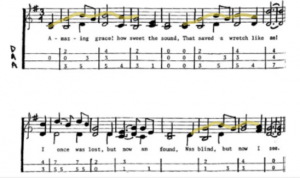 of Amazing Grace, we see a repetitive pattern (look at the sequence of uppermost notes under “Amazing…sound,” “That…me” and “was…see” differing only in the final note). Memory and repetition play a part in how the melody strikes us. It is a sequence in time, and duration gives emphasis. Can one imagine all these notes existing simultaneously?
St. Augustine made the point that we perceive time by perceiving events in sequence. As with other insights of the wise saint, this view is echoed in contemporary psychology and neurology, as I’ll try to demonstrate below.
WILLIAM JAMES: THE STREAM OF CONSCIOUSNESS
William James, a great American philosopher and psychologist, was one of the founders of the philosophical school of Pragmatism. In his seminal work, The Principles of Psychology, he proposed a theory of how we perceive time (Chapter XV).
James dismissed the notion that we perceive time as a sequence of separated, isolated events. This would be “like a glow-worm spark, illuminating the point it immediately covered, but leaving all beyond in total darkness” (Chapter XV). He emphasized that we link consciousness of events in the present to memory of events in the past and the expectation of future events:
…all our concrete states of mind are representations of objects with some amount of complexity. Part of the complexity is the echo of the objects just past, and, in a less degree, perhaps, the foretaste of those just to arrive. Objects fade out of consciousness slowly… These lingerings of old objects, these incomings of new, are the germs of memory and expectation, the retrospective and the prospective sense of time. They give that continuity to consciousness without which it could not be called a stream. [emphasis added] (Vol. 1, Chapter XV)
The reader will note how “these lingerings of old objects, these incomings of new” echoes St. Augustine’s picture of how we perceive time.
According to James, the perceived “present” is not a point in time, but an interval:
…the practically cognized present is no knife-edge, but a saddle-back, with a certain breadth of its own on which we sit perched, and from which we look in two directions into time. The unit of composition of our perception of time is a duration, with a bow and a stern, as it were—a rearward- and a forward-looking end” (loc.cit.)
OLIVER SACKS: HOW SLOW, HOW FAST WE THINK
What is the speed of time? James observed that the more events in a given day for us, the faster time passes. Oliver Sacks, a contemporary psychiatrist, has shown how the speed of time in consciousness varies according to one’s mental state. In his book, The River of Consciousness, Sacks discusses how fast or slow mental processes can go in normal activities and for disturbed mental states. There are extreme cases when time seems to slow down and when it speeds up. Some of these occur in life-threatening circumstances, some during activities requiring subconscious skills, and some are the result of neurological or psychological disorders. However, all are evidence that the brain sets its own clock.
A man jumps from a high building and his life passes before him. That’s a familiar image, and it’s also a true one. Sacks recounts several stories of how time slows down in such situations: a race car driver thrown 30 feet into the air in a crash experiences his accident calmly, in slow motion: “It seemed like the whole thing took forever. Everything was in slow motion, and it seemed to me like I was a player on a stage and could see myself tumbling over and over… as though I sat in the stands and saw it all happening… but I was not frightened.”
Sacks tells how time and motion slow down or speed up in some psychological disorders and how psychoactive drugs also change time action and perception. He relates the story of one such patient, Hester Y, who suffered from postencephalitic parkinsonism, and was treated with L-dopa: “If she had previously resembled a slow-motion film, or a persistent film frame stuck in the projector, she now gave the impression of a speeded-up film, so much so that my colleagues, looking at a film of Mrs. Y, which I took at the time, insisted that the projector was running too fast.”
So we see that the brain governs the speed at which we act and perceive time. The mechanism to achieve this employs memories and, on a level of molecular biology, neurochemical agents.
WHAT NEXT
Although the reader may be familiar with much of what has been presented above, I have provided it as a background/context/framework for the central thesis of this series: what science says about time and how that informs a theology of time. In the next article, I will explore time as a necessary actor in how the universe works, entropy as the “arrow of time,” and, following Ilya Prigogine’s Nobel Prize studies, how disorder leads to order, a seeming violation of what the Second Law of Thermodynamics says about entropy.
I have alluded to the relation of the B-theory picture of time to the block universe picture of a universe in which time is only a place-holder for a location in a four-dimensional entity. The debate about this concept, and how it relates to free will and God’s providence is ongoing; in the third article of this series, I will set this notion into a context consonant with Catholic teaching.
From The Narthex
A great man has died. Dr. Hasuda Taiji (1936-2020) passed away in late October, leaving…
Fall arrived this week, precisely on Monday at 2:19 p.m. Another year is slowly bending…
A peculiar subset of modern moral corrosion is metal theft: the stealing of objects ranging…