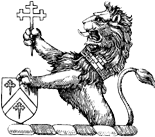
St. Augustine’s Community at Hippo
Pope Leo XIV follows the saint in living among religious men who spread the faith -- Part 2

In Part 1 (linked below) I discussed Pope Leo’s plans to continue to live in community as pope, St. Augustine’s description of friendship, short biographies of two friends with whom he did not live in community, and the communities of Cassiciacum, where he prepared for baptism, and Thagaste, his hometown in north Africa. Now I turn to his community in Hippo where he was priest, and then bishop, and the men who lived in community with him.
The third locale where Augustine lived in community was in Hippo (current day Annaba, Algeria). Augustine relocated from Thagaste to Hippo when he was ordained a priest for Hippo in 391, at which time he formed a religious community of priests and those preparing for ordination. When Augustine was made the bishop of Hippo in 396, the community moved to the bishop’s house. All seven friends were ordained, became bishops, and founded similar communities.[i] Possidius relates the following:
Soon after he [Augustine] had been made presbyter [that is, priest] he established a monastery within the church and began to live with the servants of God according to the manner and rule instituted by the holy apostles. The principal rule of this society was that no one should possess anything of his own, but that all things should be held in common and be distributed to each one as he had need, as Augustine had formerly done after he returned to his native home [Thagaste] from across the sea…[ii]
Clothing, furniture, tableware, food were all frugal.[iii] Around 400 A.D., Augustine wrote De opere monachorum (“On the Work of Monks”) declaring that monks must perform manual labor.
We know, from a sermon by St. Augustine, that the community was going strong 30 years later in 425/26. In addition to Bishop Augustine were nine men: two priests, five deacons, and two subdeacons.[iv]
Friends in Community of Hippo
Let us turn to the nine men who were the initial members with Augustine of the Hippo community: Nebridius, Alypius, Evodius, Servus, Possidius, and briefly Profuturus, Fortunatus, Urbanus, and Peregrinus.
Nebridius[v]
Augustine left his hometown of Thagaste for the major city of Carthage in 370-71 at age 16 to take advanced studies in rhetoric, and he soon began teaching the subject. He met Nebridius, a native of the area around Carthage and about the same age as Augustine.[vi] They became close friends. Augustine returned to his hometown of Thagaste and taught there before returning to Carthage to again teach. In 384, age 30, he took a position teaching rhetoric in Milan. Both Alypius (discussed below) and Nebridius moved with him. Augustine wrote that Nebridius
had left his rich family estate and his house and his mother, for she would not come with him. All these things he had left and had come to Milan for no other reason than to be with me: for with a real passion for truth and wisdom, he was in the same anguish as I and the same uncertain wavering; and he continued his ardent search for the way of happiness and his close investigation of the most difficult questions. Thus there were together the mouths of three needy souls [referencing Alypius as well], bitterly confessing to one another their spiritual poverty and waiting upon You…And amidst the bitter disappointments…, darkness clouded our souls as we tried to see why we suffered these things. And we turned away in deepest gloom saying, “How long shall these things be?” This question was ever on our lips, but all for that we did not give up our worldly ways, because we saw no certitude which it was worth changing our way of life to grasp.[vii]
In a later place in Confessions, Augustine writes of the life of Nebridius and of his death in 390.[viii]
Alypius[ix]
St. Alypius of Thagaste became a student of Augustine’s in Thagaste, and subsequently in Carthage.[x] Alypius and Nebridius both relocated from Rome to Milan when Augustine became a professor of rhetoric there in 384.
Alypius was with Augustine in the famous scene of a garden in Milan when Augustine decided to convert. Very soon after, in the garden, Alypius decided to convert. I have already recounted that Alypius joined Augustine in community before the Easter Vigil in 387 when Augustine was baptized. Alypius was himself baptized at the same time. After living in community with Augustine in Thagaste and then in Hippo, Alypius was ordained and became bishop of Thagaste from 394 to his death about 430.
Augustine described Alypius as “the brother of my heart” and, in a letter to the scholar of the Bible, Saint Jerome, written in 394 or 395, he stated that “anyone who knows us both would say that he [Alypius] and I are distinct individuals in body only, not in mind; I mean in our harmony, trust, and friendship.”[xi]
Evodius[xii]
Like Alypius, Evodius too was from Augustine’s hometown Thagaste. But the two of them did not meet in Thagaste. They met in Milan. At that time, Evodius had been baptized and had given up a career in the civil service to devote his life to God. It was in the context of describing Evodius that Augustine wrote about choosing Thagaste as the place to live in community.[xiii] As mentioned above, that trip was interrupted and postponed by a year, by the unexpected death of Monica, Augustine’s mother. At her funeral, Evodius sang Psalms.[xiv]
Evodius was ordained shortly after Augustine’s ordination of 391 and, in 396/7 or 400 (reports differ), became bishop of Uzalis, a small town near Carthage.
Evodius is mentioned by Augustine throughout Augustine’s major work De libero arbitrio voluntatis (On Free Choice of the Will) the first book of which was written in 388 and the second two books in 391-395. Evodius was a protagonist against the Donatists and Pelagians. He died circa 430. Augustine himself died on August 28 of that year.
Severus
Severus knew Augustine from their days as fellow students in Thagaste. There is no mention of him in the Confessions. He was in Milan at the same time as Augustine. By that time, Severus was baptized. Severus was among those who relocated with Augustine from Milan to Thagaste to form a lay community.
After Augustine was ordained, Severus also was ordained and became a member of the priestly community attached to the bishop’s house in Hippo. Later, as bishop in Milevi (a.k.a Milevus; now Mila), about 110 miles from Hippo, he formed his own priestly community in the bishop’s house. He died circa 426, four years before Augustine.[xv]
Possidius
According to Weiskotten,[xvi] St. Possidius was born between 360 and 370. He joined the community in Hippo very nearly after it started. Weiskotten reports:
For the first five or six years of their acquaintance he lived in that intimacy of daily companionship which makes or breaks a friendship as nothing else can, dwelling in the same house, eating at the same table, sharing in the same duties and experiencing the same trials and temptations.
In 397, Possidius was made bishop of Calama, in the Roman province of Numidia, now Guelma, Algeria, 40 miles from Hippo. In 408, he narrowly escaped death when pagans burned his church while he hid in it.
In a letter of 409, Augustine wrote to Bishop Memorius that Possidius was a person “in whom you will find no small traces of me…” He added: “For by my efforts he has been brought up not on those studies which men who are enslaved to every kind of lust call liberal, but on the bread of the Lord, insofar as it could be supplied to him from my meagre store.”[xvii]
Weiskotten reports:
When the Vandals invaded Africa in 428, Calama was one of the many towns which fell into their hands. Possidius took refuge with Augustine at Hippo, one of the three cities which still maintained their independence. There he witnessed the death of Augustine in 430 and remained till the siege of Hippo was abandoned by the Vandals in 431.
Weiskotten notes that the last mention in the historical record of Possidius is in 437.
Profuturus, Fortunatus, Urbanus, Peregrinus
These four men were all ordained and subsequently made bishop: Profuturus and Fortunatus of Cirta, the ancient capital of the kingdom of Numidia, now Constantine, Algeria, 75 miles from Hippo; Urbanus of Sicca Veneria, now El Kef, Tunisia, 75 miles from Hippo as the crow flies; and Pereginus of Thenae, near current Sfax, Tunisia, on the Mediterranean coast, nearly 350 miles from Hippo.[xviii]
Conclusion
Pope Leo XIV’s desire to live in community while serving as pope is clearly within the tradition of St. Augustine and his closest friends, each of whom themselves started their own communities as bishops.
[A link to Part 1 is here.]
[i] AUGNET : 1203 Hippo community
[ii] Weiskotten, trans., Possidius, Life of Augustine, ch. 5 (1919). Possidius, Life of St. Augustine (1919) pp.39-145.
[iii] . AUGNET : 1203 Hippo community (citing Possidius)
[iv] AUGNET : 1203 Hippo community
[v] For more on Nebridius, see AUGNET : 1417 Nebridius; Dictionary of Christian Biography and Literature to the End of the Sixth Century/Nebridius, a friend of St. Augustine – Wikisource, the free online library
[vi] Book Four, ch. 3.6.
[vii] Book Six, ch. X, 17.
[viii] Book Nine, ch. III.6.
[ix] For more information about Alypius, see Alypius of Thagaste – Wikipedia; AUGNET : 1412 Alypius; and CATHOLIC ENCYCLOPEDIA: St. Alypius; St. Alypius — Midwest Augustinians
[x] Book Six, ch. VII.11.
[xi] Letter to St. Jerome, No. 9 (or XXVIII), James Houston Baker, trans., St. Augustine: Select Letters (1930), p. 57, Full text of “L 239 St. Augustine Select Letters”. While it is reported that Alypius died in 390, it does not seem that this date is consistent with the tense of the verbs in the letter to St. Jerome said to have been written in 394/95.
[xii] For more on Evodius, see Evodius – Biblical Cyclopedia; AUGNET : 1415 Evodius; and Letter from Augustine: https://www.newadvent.org/fathers/1102164.htm
[xiii] Book Nine, ch. VIII.17.
[xiv] Book Nine, ch. XII.31.
[xvi] Weiskotten, Introduction to Possidius, Life of Augustine, pp. 12-18 (1919). Possidius, Life of St. Augustine (1919) pp.1-37. Translator’s Introduction.
[xvii] Letter No. 28 (Ep. CI) in James Houston Baker, trans., St. Augustine: Select Letters (1930), p. 191, L 239 St. Augustine Select Letters : Free Download, Borrow, and Streaming : Internet Archive
He writes further: “For what else can we say to those who, although wicked and ungodly, believe themselves to be men of a liberal education, except what we read in the book that is truly liberal: ‘If the Son has made you free, then shall ye be free indeed.’ For it is by His gift that whatever even those disciplines that are termed liberal by men who have not been called unto liberty, contain that is liberal, can be known at all. For they contain nothing with liberty, unless what they contain consonant with truth.”
[xviii] AUGNET : 1203 Hippo community
From The Narthex
July 21-27 is Captive Nations Week. Congress designated in 1959 the third week of July…
There is only one Savior, Our Lord Jesus Christ, the only Redeemer of the World.…
Pneumatology is that branch of theology dealing with the Holy Spirit. The Holy Spirit is…